in the game’s opening
Pokémon Origins
The concept of [Pokémon](entity:creature-recall-creature-pok-mon-c2ce520b30f2) began with fictional creatures captured, raised, and fought by human trainers. The first pair of handheld games gradually developed into an extensive entertainment world centered around collecting, training, competition, and exploration. The series' core commitment, summarized as the pursuit of completing the Pokémon [Pokédex](entity:object-recall-object-pok-dex-a3e3d5a81ea5) and
at the game’s opening
Pokémon GO Launch
[Nintendo](entity:organization-recall-organization-68a2698911af) and Niantic Lab have collaborated to create [Pokémon](entity:creature-recall-creature-pok-mon-c2ce520b30f2) GO, a mobile game that combines global positioning system, augmented reality, and familiar Pokémon mechanics. Players catch Pokémon, collect supplies, battle at gyms, evolve Pokémon, and explore locations in the real world around them
immediately after signing in
Willow’s Introduction
after logging in with a google account, dr. willow appears and introduces the starting point of the game. the player selects their gender and customizes their avatar, then is guided through the first capture. this introductory process transforms the abstract game setting into a personal journey. the avatar becomes a visible representation
moments later
Starter Pokémon Choice
Three initial [Pokémon](entity:creature-recall-creature-pok-mon-c2ce520b30f2) appear, the player can only choose one. After choosing one, the other Pokémon disappear, making this first choice seem like a formal rite of passage into the role of a trainer
during the first encounter
Pikachu Starter Trick
Players who want [Pikachu](entity:creature-recall-creature-pikachu-85082e1a47e8) need to temporarily avoid the first three [Pokémon](entity:creature-recall-creature-pok-mon-c2ce520b30f2) that appear. Instead, they should keep moving away until the initial Pokémon disappear and reappear, repeating this process four times
immediately after the first capture
First Pokémon Inspection
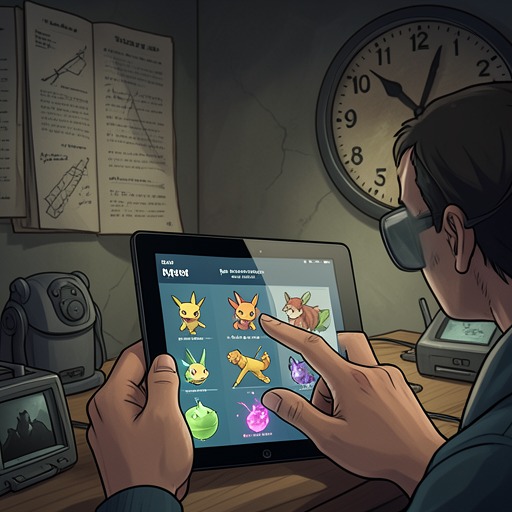
New captured [Pokémon](entity:creature-recall-creature-pok-mon-c2ce520b30f2) will be presented through attribute data and resource information. Its combat power indicates strength, health points record health status, while attributes, height, weight, moves, [Stardust](entity:concept-recall-concept-stardust-64fe20337b14), and [Pokémon Candy](entity:concept-recall-concept-pok-mon-candy-c0b42d5dc349) collectively determine its actual value
after the first capture
Trainer Nickname Search
the next major obstacle is not battle, but identity: choosing an unused trainer nickname. since there are many players, finding an available name becomes surprisingly difficult, often forcing players to consider adding numbers. after the name is accepted, dr. willow continues the tutorial and confirms that the avatar must actually walk
early in the game
First Wild Encounter
When a player clicks on a wild [Pokémon](entity:creature-recall-creature-pok-mon-c2ce520b30f2), the capture interface displays its name, appearance, and battle power. The player starts with a certain number of Poké Balls, must throw them accurately, and also deal with the possible evasion of the Pokémon
after each successful capture
Capture Rewards
Successful capture rewards [Stardust](entity:concept-recall-concept-stardust-64fe20337b14), [Pokémon Candy](entity:concept-recall-concept-pok-mon-candy-c0b42d5dc349), and experience points; if the species is first captured, additional experience is also obtained. Throwing skills can also bring more experience, making accuracy valuable not just for ensuring a successful capture
early exploration
Avatar Map Tutorial
Player avatar appears on a map corresponding to the current global positioning location, with streets and detection radius displayed around it. The avatar panel shows trainer level, experience progress, log, coins, start date, team, and achievements
during the first map tour
PokéStop Discovery
Supply depots are marked on the map with monuments in the real world. When players approach, the marker changes shape. Players can rotate the photo disc and collect the generated items
after opening the central menu
Main Menu Breakdown
Central menu provides hints, [Pokémon](entity:creature-recall-creature-pok-mon-c2ce520b30f2) encyclopedia, shop, Pokémon and items. Dr. Will's hints explain the game's main systems, while the Pokémon encyclopedia records captured species and supports the long-term goal of collecting all Pokémon. The shop introduces purchase items using coins, including lucky eggs, scent attractors for
during early inventory management
Pokémon Storage Management
[Pokémon](entity:creature-recall-creature-pok-mon-c2ce520b30f2) menu allows players to sort Pokémon by capture date, favorite status, number, HP, name, or battle power. A separate area is used to store Pokémon eggs, which are placed in incubators and hatched by walking in real life
early progression
Egg Incubation System
pokemon eggs need to be walked 2 kilometers, 5 kilometers, or 10 kilometers before they can hatch. the longer the distance, the better the reward and the pokemon. each incubator can hold only one pokemon egg at a time, so players must carefully choose which eggs to put in
alongside early collection
Item Bag Limits
Item menu stores Poké Balls, Lucky Eggs, Smokes to attract [Pokémon](entity:creature-recall-creature-pok-mon-c2ce520b30f2), Revives, healing items, bait modules, Berries, and Incubators. After the trainer levels up, they will get more items, but the item box can only hold a limited number
after assembling useful items
Lucky Egg Experience Plan
The guide recommends activating a [Lucky Egg](entity:object-recall-object-lucky-egg-40028b98a6ba) together with [Incense](entity:concept-recall-concept-incense-f68f6c1d6cdb) and, ideally, a [Lure Module](entity:object-recall-object-lure-module-b76f775d5caa). Incense draws [Pokémon](entity:creature-recall-creature-pok-mon-c2ce520b30f2) toward the player, while a Lure Module concentrates them around a [PokéStop](entity:location-recall-location-pok-stop-b9d62da1a72c); the Lucky Egg doubles experience gained during the active period.
The player is advised to save Pokémon and candy beforehand, then capture creatures continuously and evolve as many as possible near the end of the Lucky Egg’s duration. The plan turns preparation and timing into a substantial experience boost.
before major leveling sessions
Resource Conservation
Early players are warned not to spend [Stardust](entity:concept-recall-concept-stardust-64fe20337b14) and candy immediately on their first [Pokémon](entity:creature-recall-creature-pok-mon-c2ce520b30f2). As the trainer levels up, stronger wild Pokémon become available, often making later investments more efficient.
When power-boosting a creature, the filled level ring indicates how close it is to the trainer’s current potential. Choosing a Pokémon already near that limit produces a stronger evolved result and avoids wasting scarce resources.
during exploratory play
Parking Lot Spawns
Parking lots, particularly those near PokéStops, are presented as productive hunting grounds. The guide reports seeing several common [Pokémon](entity:creature-recall-creature-pok-mon-c2ce520b30f2) appear in these open areas, including around gas stations.
The advice reflects the game’s attraction to ordinary public spaces. Locations not designed as traditional game levels can nevertheless become reliable gathering points for trainers.
during egg hatching
Unsafe Hatching Workarounds
The guide suggests that moving a phone around a room may cause an unstable GPS signal to register enough avatar movement to advance an egg toward hatching. It mentions desks and offices as possible settings for this workaround.
It also acknowledges more hazardous ideas involving dogs, ceiling fans, or record players and explicitly discourages them because they could damage the phone. The passage reveals the tension between the game’s walking requirement and players’ desire to optimize it.
after the basic tutorial
Gym Introduction
Gyms are real-world locations where teams compete for control. Their floating markers and platforms indicate [Gym level](entity:state-recall-state-gym-level-5a356f137317) and the possible number of defending [Pokémon](entity:creature-recall-creature-pok-mon-c2ce520b30f2).
Friendly gyms can be trained at to increase Prestige and level, while opposing gyms can be challenged to reduce those values. Gym play therefore extends the collection game into territorial competition.
upon first entering a gym
Gym Battle Modes
At a gym, the player chooses between training against friendly [Pokémon](entity:creature-recall-creature-pok-mon-c2ce520b30f2) and challenging an opposing team. In either mode, the defending Pokémon is controlled by artificial intelligence rather than by the human player who owns it.
The battle begins after the player selects a team of Pokémon. This structure makes gyms competitive social spaces while preserving a straightforward single-player combat interface.
during each gym battle
Battle Victory Condition
Victory requires reducing the opposing [Pokémon](entity:creature-recall-creature-pok-mon-c2ce520b30f2)’s HP to zero. The attacking Pokémon displays its HP and a blue stamina bar, while [Combat Power](entity:concept-recall-concept-combat-power-4c69cf1bcdbe) influences the damage it can inflict.
Fast moves build stamina and charge moves release heavier attacks. Combining dodges with both kinds of moves gives the player a practical method for overcoming defenders rather than relying on raw Combat Power alone.
after gym victories
Gym Rewards
Winning training battles grants trainer experience and raises the Prestige of a friendly gym. Defeating an opposing gym also grants experience while lowering its Prestige.
The rewards tie personal advancement to collective territorial status. A battle is therefore consequential even when it does not immediately place the player’s own [Pokémon](entity:creature-recall-creature-pok-mon-c2ce520b30f2) in a gym.
during gym development
Prestige Defense Structure
A gym’s strength is measured by Prestige. Friendly victories increase it, while defeats reduce it; if Prestige reaches zero, the gym becomes open for any team to claim.
As Prestige rises, additional defense slots appear, allowing more friendly players to assign one [Pokémon](entity:creature-recall-creature-pok-mon-c2ce520b30f2) each. Higher gym levels support more defenders and carry higher maximum Prestige, turning maintenance into a continuing team effort.
before challenging an opposing gym
Type Matchup Strategy
The guide urges players to match attacking [Pokémon](entity:creature-recall-creature-pok-mon-c2ce520b30f2) against the weaknesses of opposing types. Water is countered by Electric or Grass, Fire by Water, Ground, or Rock, and other types have similarly specified counters.
This type chart gives underpowered trainers a way to damage a gym intelligently. Knowledge of elemental relationships can compensate for a numerical disadvantage and makes team selection a strategic act.
at the start of gym combat
Opening Dodge Advantage
Swiping left or right to dodge immediately can create an extra attack or two before the opponent responds. The technique is especially useful for smaller, quicker [Pokémon](entity:creature-recall-creature-pok-mon-c2ce520b30f2) whose rapid attacks allow them to strike and evade before a larger defender reacts.
Dodging introduces timing and reflex into a system otherwise governed by statistics. It gives nimble Pokémon a tactical identity beyond their [Combat Power](entity:concept-recall-concept-combat-power-4c69cf1bcdbe).
after an opposing gym falls
Neutral Gym Capture
When repeated defeats reduce a gym to a neutral white state, any team can place a [Pokémon](entity:creature-recall-creature-pok-mon-c2ce520b30f2) there. The guide recommends waiting for an opponent to complete the difficult work of taking the gym, then moving quickly to claim it.
A player can also exploit cooperation: one friend exhausts powerful Pokémon to defeat the gym, while another captures the neutral site and later allows the fatigued teammate to add a defender after healing.
once the trainer reaches level five
Level Five Unlock
At level five, the player can join one of three teams and participate more fully in gym competition. The choice determines whom the trainer supports when contesting gyms around the world.
This threshold changes the game from individual collection to organized rivalry. Team identity supplies the social and competitive structure behind gym ownership.
during the question-and-answer section
Trading Not Yet Available
The guide states that players cannot currently battle friends’ [Pokémon](entity:creature-recall-creature-pok-mon-c2ce520b30f2) outside gym battles and cannot trade Pokémon. Transferring a Pokémon to [Professor Willow](entity:character-recall-character-professor-willow-7b3dddf6d572) is described as release rather than exchange.
These limitations define the early social boundaries of the game. Players can compete indirectly through gyms and share spaces, but direct ownership transfer and friendly battles remain outside the available systems.
during the question-and-answer section
Medals and Future Features
Players can earn medals for achievements such as catching many [Pokémon](entity:creature-recall-creature-pok-mon-c2ce520b30f2) of one type or walking a particular distance, though the guide says the medals offer little practical benefit beyond prestige. It also mentions the planned [Pokémon Go Plus](entity:object-recall-object-pok-mon-go-plus-1cc08df0238d) accessory as a possible expansion of play.
The wearable could alert players to nearby Pokémon and PokéStops and permit limited interaction without removing the phone from a pocket. Yet the phone must still run the game in the foreground, so the accessory is presented as optional rather than essential.
during early practical questions
Battery and Data Concerns
Because the screen, GPS, and online connection remain active, [Pokémon](entity:creature-recall-creature-pok-mon-c2ce520b30f2) GO may consume substantial battery and some mobile data. The guide recommends disabling the camera, zooming out, and enabling battery-saving options to reduce the drain.
It also mentions downloading Google maps in advance as a possible way to reduce data use, while acknowledging that the result is not confirmed. Device limitations become part of the practical challenge of sustaining exploration.
during neighborhood exploration
Moving Leaf Spawns
Fluttering green leaves are interpreted as signs of a possible [Pokémon](entity:creature-recall-creature-pok-mon-c2ce520b30f2) spawn point. Waiting in the area may produce creatures that do not appear on the nearby radar, although the guide stresses that a rare Pokémon is not guaranteed.
The leaves do not identify the exact location of a tracked creature. They instead mark a chance-based environmental signal, encouraging patience without promising a particular encounter.
while searching for a nearby Pokémon
Nearby Footprint Tracking
The nearby panel can display up to nine [Pokémon](entity:creature-recall-creature-pok-mon-c2ce520b30f2), each marked by footprints indicating approximate distance. Zero footprints suggest an imminent encounter, while one, two, or three footprints signal increasing distance and the need to adjust direction.
By watching a selected Pokémon move up or down the list while walking, the player can infer whether the chosen route is correct. The method is imperfect, but it converts an otherwise opaque search into a process of trial, error, and deduction.
during nearby searches
Radar Ring Range
A radar ring around the avatar represents the player’s effective detection range. It can reveal a [Pokémon](entity:creature-recall-creature-pok-mon-c2ce520b30f2) near the boundary of a restricted property, allowing the player to encounter it without entering places such as police stations.
A separate green box indicates that the nearby list is updating, not necessarily that the tracked Pokémon is closer. Understanding the distinction prevents the player from mistaking a system refresh for directional progress.
during advanced searching
Rare Pokémon Habitats
Rare [Pokémon](entity:creature-recall-creature-pok-mon-c2ce520b30f2) are said to appear in particular places and at particular times. The guide associates some creatures with evening hours and suggests that element-based Pokémon may appear near real-world environments resembling their elements.
Evolved forms can also be caught in the wild, though they are much rarer than their unevolved counterparts. High-Combat-Power creatures are harder to capture and may require repeated throws, stronger balls, or Razz Berries.
near the end of the instructional guide
Eevee’s Three Evolutions
[Eevee](entity:creature-recall-creature-eevee-c486056790ed) requires twenty-five Eevee Candy to evolve and can branch into three forms: [Vaporeon](entity:creature-recall-creature-vaporeon-b2b9db6924a0), [Jolteon](entity:creature-recall-creature-jolteon-b214480408ce), or [Flareon](entity:creature-recall-creature-flareon-bd8aa3293c03). Each evolution represents a different elemental identity—Water, Electric, or Flame.
Because Eevee is described as rare, collecting enough candy takes time. Its branching evolution makes it a memorable example of how scarcity and choice interact within the [Pokémon evolution](entity:action-recall-action-c57740d5a29a) system.
after the guide’s instructional material
Night Ride Begins
The final narrative shifts from advice to a horror story told by a [Pokémon](entity:creature-recall-creature-pok-mon-c2ce520b30f2) GO player. The narrator, a longtime gamer and Pokémon fan, embraces the game because it encourages him to leave the house and explore a city where he has lived only a few months.
He spends lunch breaks collecting from PokéStops and visiting gyms, then begins riding his bicycle after work to find more. The game’s promise of healthy exploration gradually becomes a reason to travel farther and later than caution would recommend.
one night after work
Cemetery PokéStop Discovery
While riding after dark, the player notices an enormous concentration of PokéStops on the augmented-reality map. Looking up, he realizes that the supposed gold mine is a [Cemetery](entity:location-recall-location-cemetery-8e90d96f48df).
Although he respects the supernatural and understands the risk of entering a Cemetery at night, he locks his bicycle at the entrance, takes a flashlight, and walks among the graves collecting items and encountering ghost-type [Pokémon](entity:creature-recall-creature-pok-mon-c2ce520b30f2). The game’s incentives draw him into a place he might otherwise have avoided.
shortly after entering the Cemetery
The Large Mausoleum
The player reaches a section filled with mausoleums, including one especially prominent [Large Mausoleum](entity:location-recall-location-large-mausoleum-2ef83019f0b4). As he approaches, his phone floods with notifications for ghost-type [Pokémon](entity:creature-recall-creature-pok-mon-c2ce520b30f2), producing an unusually dense cluster of encounters.
A [Gengar](entity:creature-recall-creature-gengar-0d94fe9ac4c6) appears near the entrance, apparently a rare third-evolution Pokémon. While attempting to catch it, the player notices a narrow beam of light leaking from the mausoleum door and abandons the last of his precautions.
moments later
Mausoleum Descent
The player enters the [Large Mausoleum](entity:location-recall-location-large-mausoleum-2ef83019f0b4) and sees what appears to be a strange interior lit by hanging flames. Decaying bodies lie inside, and four steps are concealed behind the side associated with the husband.
He descends, hearing a familiar blood-curdling scream on the first step and encountering silence on the second. The descent transforms a risky nighttime game excursion into an apparently physical nightmare.
at the bottom of the steps
Hidden Laboratory
The third step reveals a concrete chamber with six human-sized openings, countless vials, and tubes filled with blood, organs, and chemicals. On the fourth step, six masked men come into view around a table holding a naked body.
The room suggests an organized, hidden experiment rather than a random apparition. Its medical horror gives the player a disturbing explanation for the scream and makes the mausoleum feel like a concealed crime scene.
at the laboratory revelation
The Duplicate Body
The body on the table looks exactly like the player, down to his hair, face, physique, and a birthmark on his thigh. It is restrained and visibly marked, while the familiar scream seems to come from it.
The discovery collapses the boundary between observer and victim. Whether the body is a copy, a supernatural double, or a hallucination, the player experiences it as an image of his own possible destruction.
immediately after seeing the duplicate
Flight from the Mausoleum
The player drops his phone and runs, forgetting [Pokémon](entity:creature-recall-creature-pok-mon-c2ce520b30f2) entirely. He reaches his bicycle and searches desperately for his keys, only to realize that both the keys and the phone may still be near the masked men.
He is more than five miles from home and values the bicycle and phone too highly to abandon them. Despite understanding the danger, he chooses to return with only a small pocketknife for self-defense.
shortly afterward
Return to the Cemetery
Moving back through the graves, the player searches for his keys while repeatedly looking toward the mausoleums. He finds no sign that anyone followed him and no immediate evidence that the masked group has emerged.
The return is driven by necessity rather than courage. His missing possessions pull him back toward the place where the story’s impossible revelation occurred.
minutes after the flight
Vanished Laboratory
The [Large Mausoleum](entity:location-recall-location-large-mausoleum-2ef83019f0b4) is now completely sealed, without a crack, light, or sound. In a burst of confused anger, the player smashes through the door and finds the couple, the stairs, his phone, and his keys—but no masked men, body, laboratory, vials, or containers.
The disappearance leaves the event suspended between supernatural encounter and psychological break. The physical presence of his belongings proves that he was there, but the absence of every other trace undermines any stable explanation.
on the bicycle ride home
Police Call Homeward
The player retrieves his possessions, rides away, and calls the police to report what happened. A night dispatcher promises to send a patrol but doubts that officers can do much, while the player’s friends later refuse to believe the story.
The final consequence is not a solved mystery but isolation. He remains convinced that he saw the duplicate and the hidden laboratory, yet the story closes with the destabilizing possibility that he may have seen nothing at all.